
The newest CAD/CAM software trends for 2027 are CAM automation and feature recognition, full-machine simulation inside the CAM tool, cloud-native CAD+CAM+PDM platforms (with a counter-move toward local data control), open automation APIs, and vendor consolidation. Most of the 2026 announcements behind these trends are still roadmap items, and what already works today is add-on CAM assistants and cloud CAM inside Onshape.
CAD/CAM software trends for 2027: evidence and status of each
Six trends have dated evidence behind them, and only part of that evidence describes products you can buy now.
| Trend | Dated evidence | Status | What to do in 2027 |
|---|---|---|---|
| CAM automation and feature recognition | Autodesk Fusion roadmap (6 Oct 2026); CloudNC CAM Assist (Sep 2026); Mastercam 2027 (reported 19 Nov 2026) | Fusion: Planned. CloudNC: Shipped. Mastercam: Announced | Programming-heavy shops: pilot an add-on assistant on your own benchmark parts |
| Simulation inside the CAM tool | Fusion turn-mill simulation (6 Oct 2026); Onshape 1.209 workholding (9 Jan 2026) | Fusion: Planned. Onshape: Shipped | Turn-mill and multi-setup shops: ask for a demo on a model of your own machine |
| Cloud CAD+CAM+PDM in one platform | Onshape CAM Studio adaptive cutting (9 Jan 2026); Inventor as Fusion Connected Client (15 Sep 2026) | Onshape: Shipped. Inventor link: Planned | Teams without PDM: price one platform against your current tool stack |
| Local data control | Fusion Local Documents (6 Oct 2026) | Planned (in development) | Regulated or customer-controlled work: score data residency as a criterion |
| Open automation APIs | Fusion Compute MCP (6 Oct 2026) | Public beta | CAD admins: test on non-sensitive data before relying on it |
| Vendor consolidation | Siemens–Altair (26 Mar 2025); Cadence–Hexagon D&E (23 Feb 2026); Schneider–PTC (5 Oct 2026) | Closed; Closed; Pending, close expected by Q3 2027 | PTC users: review change-of-control terms before renewing. Altair and MSC users: check renewal pricing and licence packaging under the new owner |
How to read the labels: Shipped means it is in a released version, Beta means usable but unfinished, Planned means the vendor has said it intends to build it but has not shipped it, Announced means reported by trade press with the release not verified on the vendor’s own site, and Pending or Closed refers to the state of a deal.
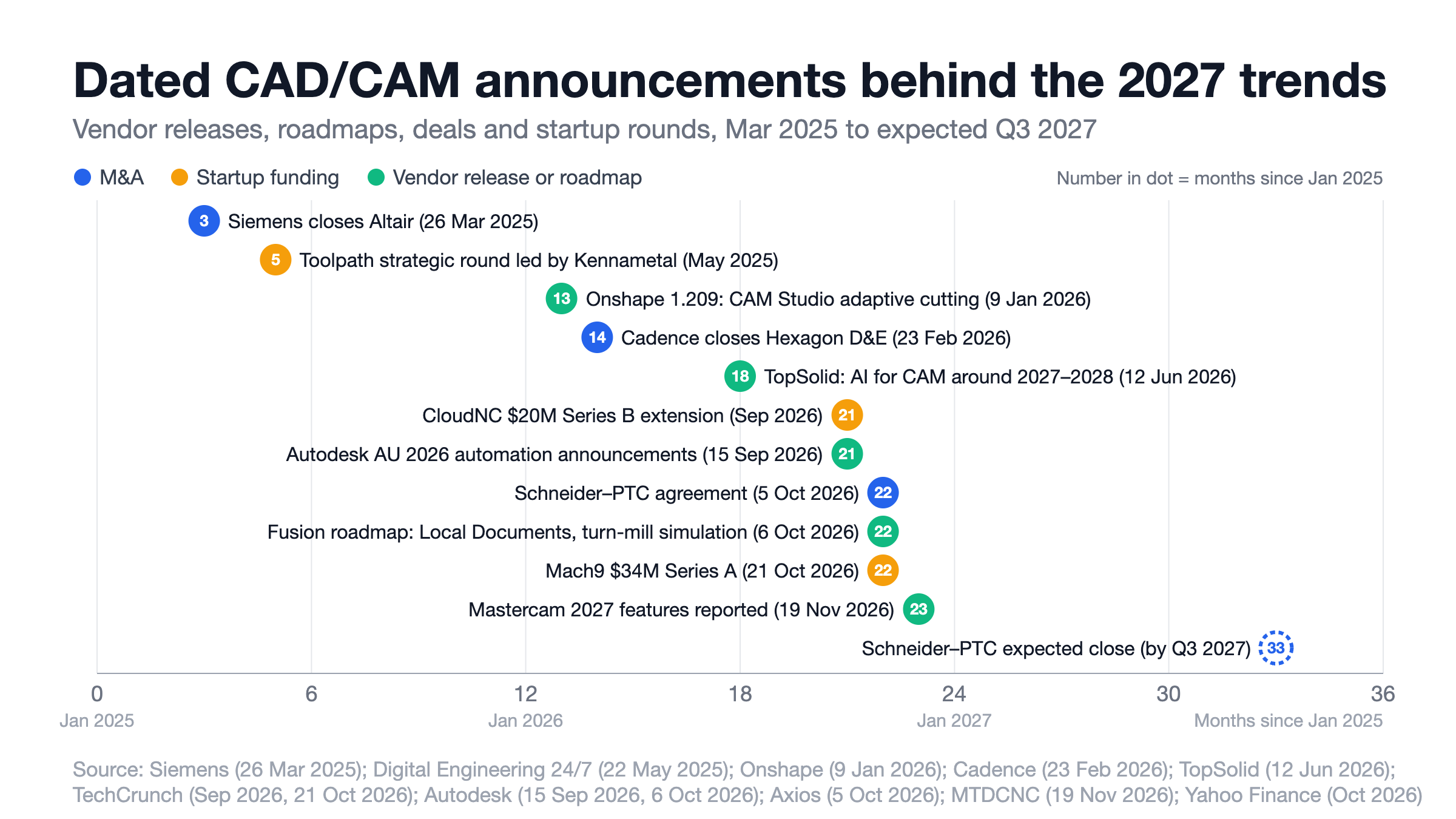
CAM automation and feature recognition: mostly planned, partly shipping
The vendor direction is consistent: the software proposes, the programmer decides. Autodesk’s Fusion manufacturing roadmap of 6 October 2026 says Instant Prismatic Machining “is intended to generate toolpaths for standard features”, with pocket, hole and fillet recognition in progress. Recognition is meant to “propose the work while the programmer makes the final decision”, and the generated operations stay standard, editable Fusion operations. Every item is worded as intended or planned, not shipped.
Editability matters more than speed. If a recognised feature changes in the next design revision, the operation should behave like any other: see how integrated CAD/CAM flags toolpaths for regeneration after design changes.
The same roadmap describes System Modeler, a node-graph tool for building reusable manufacturing workflows: orienting the part, creating the setup, selecting tools. Autodesk says these workflows can be “packaged, versioned, and shared”, and its AU 2026 announcement (15 September 2026) says it helps “automate machine setup, toolpath generation, and production preparation workflows”. Status: intended.
A useful counterweight comes from another vendor. In a June 2026 trends piece, TopSolid says AI in the strict sense is “not yet being used for CAM” and puts the timeline for the most advanced machining functions at “around 2027–2028”. The automation it says works today is unglamorous:
- parameterised component libraries;
- cutting-tool libraries imported through ISO 13399, the standard format tool makers use to describe tool geometry and data;
- associative reprogramming when the part geometry changes.
TopSolid also claims up to 70% less roughing time with its Boost Milling trochoidal strategy. That is the vendor’s own figure and has not been independently checked.
Mastercam 2027 adds enhanced multiaxis, more powerful deburring, “AI-powered assistance through Mastercam Copilot” and a first look at EverPath Technology’s real-time toolpath experience. These details come from an MTDCNC report (19 November 2026) of Mastercam’s LinkedIn post; we have not verified the release date on Mastercam’s own site.
What you can actually buy today is rule-based automation inside your CAM, plus add-on assistants such as CloudNC’s CAM Assist (covered below).
Simulation moves into the CAM tool
Full-machine simulation is moving from a separate verification step into the CAM environment. Autodesk plans full turn-mill machine simulation in Fusion that would simulate the complete kinematic machine, including tools, tool blocks and turning fixtures, before a job runs. Status: planned.
Onshape has shipped a smaller step. Its 1.209 release (9 January 2026) adds job-level workholding selection in CAM Studio, so simulations show only the fixtures relevant to that job.
This matters most for turn-mill, multi-setup and five-axis work, where a collision is expensive and fixtures change between operations. Whether in-CAM simulation can replace dedicated verification software is a question our sources do not answer either way. When you evaluate, ask whether the simulation runs on the CAM toolpath or on the post-processed NC code, and whether the vendor can supply an accurate model of your machine.
Cloud-native CAD+CAM+PDM, and the counter-trend toward local data control
The single-platform cloud model is shipping. PTC acquired the cloud CAM system Cloudmilling and now offers it inside Onshape as CAM Studio. The January 2026 release added:
- adaptive cutting (constant chip load) for 2D roughing, 3D roughing and flatlands, in all versions of CAM Studio;
- work planes and datums, datum overrides and WCS shift;
- spindle direction set automatically from tool hand;
- automatic flat-pattern DXF generation for sheet-metal parts when a release syncs to Arena (Arena-side update scheduled “on or before January 11, 2026”).
Autodesk is moving the same way from the desktop side. Its AU 2026 news says “Inventor will also become the first Fusion Connected Client”, linking desktop Inventor with cloud data and processes in Fusion.
The counter-trend comes from Autodesk too. It is developing “Local documents” for Fusion for Manufacturing so manufacturers can keep designated sensitive project data “under their organization’s local control”, and concedes that cloud storage “simply isn’t an option” for some projects. When data is kept local, Fusion is planned to “restrict capabilities that would require that model data to be uploaded to Autodesk cloud”. Status: in development.
The practical conclusion: data residency is now a real 2027 evaluation criterion, and so is the list of features you lose by keeping data local. Map which way data flows between CAD, PDM, PLM and ERP before you move CAM into a cloud platform, and decide whether your team needs PDM or full PLM rather than inheriting whatever the platform bundles.
Open APIs and AI assistants: a brief note
CAD/CAM systems are opening their APIs for automation. Fusion Compute MCP, a cloud-hosted Model Context Protocol server, is in public beta, and Autodesk says “More than 7,000 endpoints are planned” through Fusion’s TypeScript API, covering modelling, CAM templates and toolpaths. Autodesk Assistant uses Inventor’s APIs and iLogic, and Vault adds natural-language search (15 September 2026). For how AI is being applied in design tools, see our sister site’s guide on how machine learning is being applied in CAD.
Vendor consolidation: who owns your CAD/CAM and CAE tools in 2027
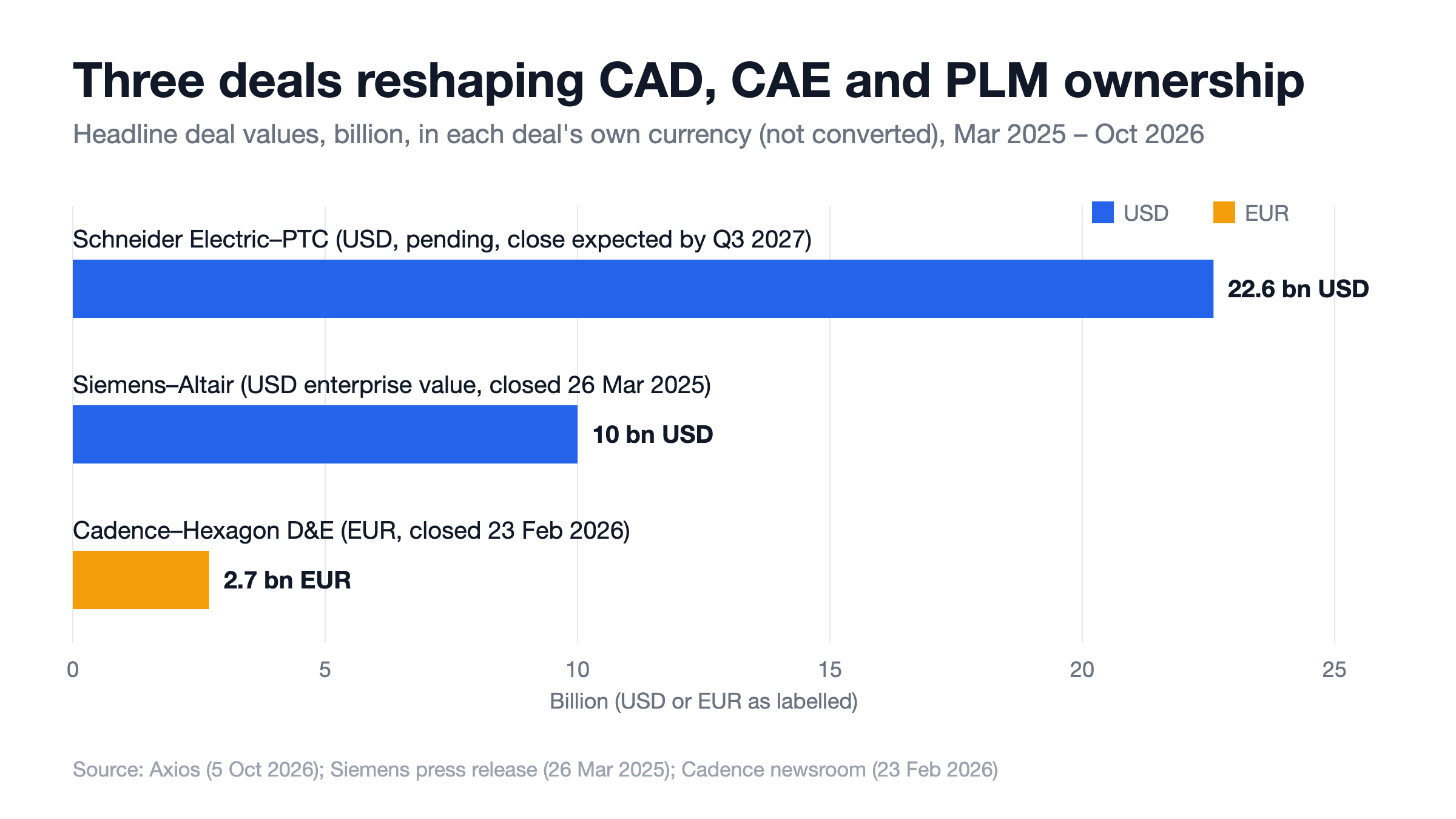
Three deals change who owns tools that many small and mid-sized manufacturers use:
- Siemens–Altair, closed 26 March 2025. Siemens put the enterprise value at approximately USD 10 billion at closing; Altair’s 8-K headline at signing said $10.6 billion, or $113.00 per share in cash. Altair’s simulation, HPC and data science tools join Siemens Xcelerator.
- Cadence–Hexagon Design & Engineering, closed 23 February 2026. The business includes MSC Software, MSC Nastran and Adams. Cadence reports a price of about €2.7 billion, including an estimated €150 million of transaction-related taxes, paid 70% in cash and 30% in stock, and expects an incremental $160 million of 2026 revenue.
- Schneider Electric–PTC, agreed 5 October 2026, pending. About $22.6 billion, or $205 per share in cash, a 42.3% premium according to Axios. Closing is expected by Q3 2027, subject to PTC shareholder approval and regulatory clearances. PTC’s portfolio includes Creo, Windchill, Onshape and Arena.
For a PTC customer, a 2027 renewal may fall while a change of control is pending. Nobody outside the companies knows what product decisions will follow, so plan around your contract rather than predictions. Before signing multi-year terms, check:
- assignment and change-of-control clauses, and whether they give you any exit or renegotiation right;
- price caps on renewal and on any repackaging of licences;
- data export rights, in native and neutral formats, including PDM metadata and revision history.
Altair and MSC users are already past the change of control, so their questions are about renewal pricing and licence packaging under the new owner. Our clause-by-clause checklist for cloud CAD/PDM contracts covers the wording to ask for. For the deal itself, read our analysis of the Schneider Electric–PTC deal.
Startups changing CAD/CAM
The funded startups with shipping products are CAM assistants: CloudNC plugs into your existing CAM, while Toolpath is a standalone browser platform. Mach9 sits next to CAD/CAM, in civil-engineering CAD, rather than inside it.
| Startup | What it does | Disclosed funding | Verdict |
|---|---|---|---|
| CloudNC (UK, founded 2015) | CAM Assist: add-on to Fusion or Mastercam that drafts tools, approach directions, feeds/speeds and code | $20M Series B extension (Sep 2026); $128M lifetime | Worth piloting |
| Toolpath (US, founded 2021) | Standalone browser platform: toolpath generation, custom DFM, quick cost estimates | $10M seed (Sep 2024); undisclosed strategic round (May 2025); about $20M total | Worth a trial for high-mix quoting |
| Mach9 (San Francisco) | AI CAD for civil engineering, after a pivot from robotics | $34M Series A (21 Oct 2026) | Watch, civil and infrastructure only |
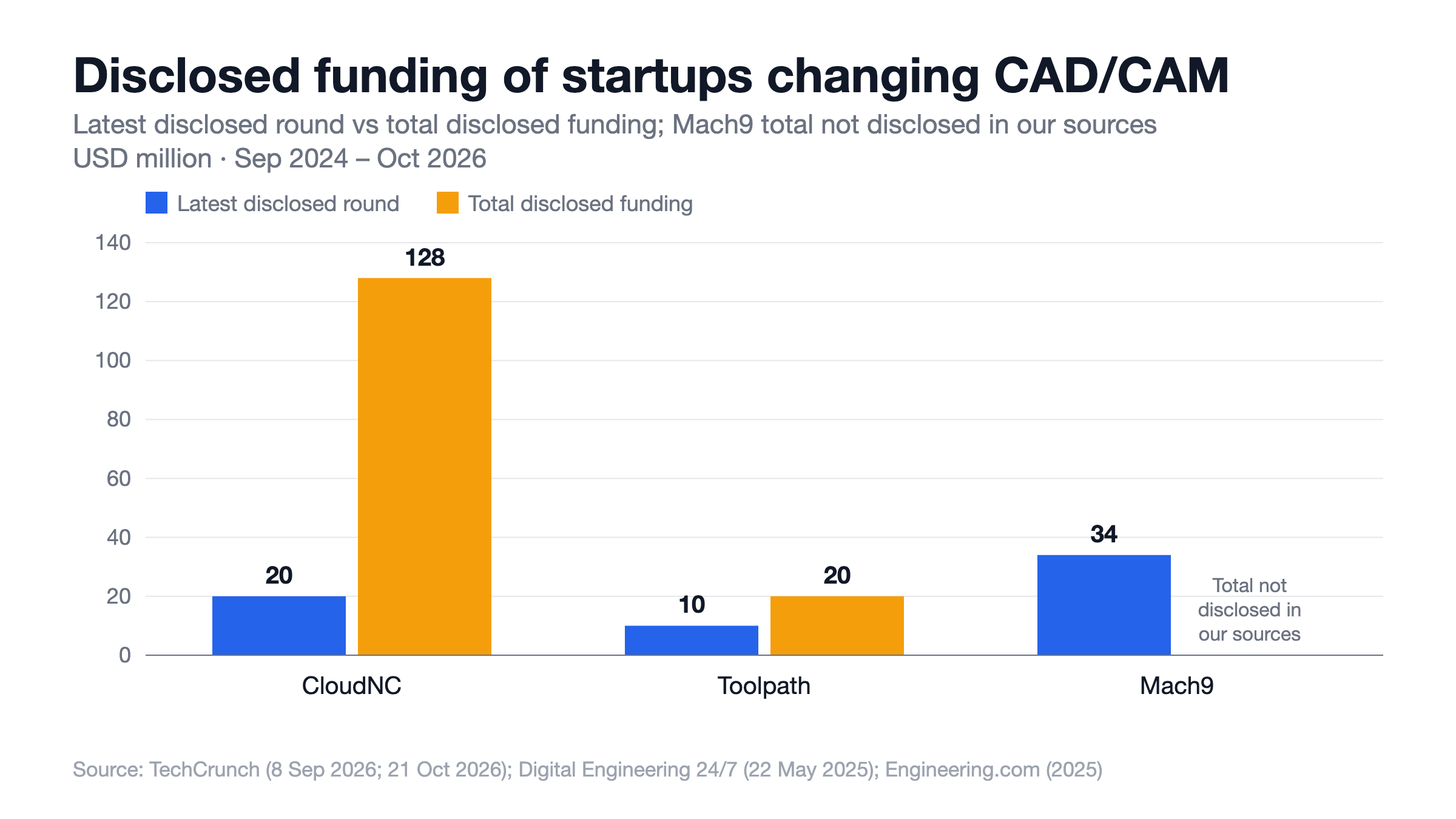
CloudNC’s September 2026 round was led by Nimble Ventures, with Calculus VC, Entrepreneurs First and LM Capital, Lockheed Martin’s venture arm. TechCrunch reports more than 1,000 machine shops using CAM Assist, 80% of customers in the US and 80 employees. The user reviews, edits and approves everything CAM Assist drafts. A cost and risk estimator, Quote Agent, was set to launch around October 2026; we have not confirmed that it did.
Toolpath was co-founded by Andy Powell and Justin Gray and is led by Al Whatmough, who previously led CAM in Autodesk Fusion. Its May 2025 strategic round was led by Kennametal; Autodesk invested in the same round. ModuleWorks is also an investor and partner. The company puts total funding at about $20 million across three rounds. Users can upload their own past programmed parts to train its strategy suggestions, and it ships with a library of Kennametal machines.
Worth piloting vs watch: our verdict
- CloudNC: worth piloting if you program in Fusion or Mastercam. You do not have to switch CAM, and the customer base and investor list suggest a product past the prototype stage. Main risk: a programmer still approves every output, so measure total review time on your own parts, not just how fast the draft appears.
- Toolpath: worth a trial for shops quoting a lot of high-mix prismatic work, where fast DFM feedback and estimates have direct value. Main risk: it is a separate platform, so check how its output reaches your existing CAM and post-processors, and read its data terms before uploading past programs.
- Mach9: watch only if you do civil or infrastructure CAD. It has no bearing on mechanical CAM.
Funding shows investor confidence, not product quality. Run any pilot on 3–5 of your own benchmark parts with a programmer timing each step.
What these trends mean for your CAD/CAM data
Each trend raises a plain data question that belongs in the evaluation, not after it.
- Where files live. Cloud CAM puts models, setups and toolpaths on the vendor’s infrastructure. Autodesk itself accepts that this “simply isn’t an option” for some regulated or customer-controlled projects, which is why it is building Local Documents. Check what your customer contracts allow before you choose.
- Who may use derived data. Toolpath invites users to upload past programmed parts to train strategy suggestions. Ask any assistant vendor whether your uploads train models used for other customers, how long they are kept and how you delete them. For customer-owned parts, you may need the customer’s permission first.
- What happens at change of control. The pending Schneider–PTC deal covers Onshape, Arena, Creo and Windchill data. Confirm your export rights now, while the terms are known.
When you share models with programmers, suppliers or a new tool, limit who can open and export them; our guide to setting permissions on CAD files shared outside the company covers the options. CADChain’s Boris plug-ins are one way to record file fingerprints, timestamps and access events for files you share, which helps show what left the company and when. They complement contract terms and PDM permissions rather than replacing them.
What to do before your 2027 renewal or CAD/CAM evaluation
- Ask each vendor to mark every roadmap item you are counting on as shipped, beta or planned, in writing.
- Pilot an add-on CAM assistant on 3–5 benchmark parts before considering a change of CAM platform.
- Standardise your tool library now, using ISO 13399 import where your CAM supports it; automation depends on clean tool data.
- Confirm that automated toolpaths stay editable and are flagged for regeneration after design changes.
- For turn-mill or multi-setup work, ask for simulation on a model of your own machine and posts, not a demo cell.
- Check whether local or on-premises storage is available for sensitive projects, and list which features it disables.
- For PTC products, review change-of-control, assignment, price-cap and data-export clauses before Q3 2027.
- Read the data terms of any startup tool before uploading past programs or customer parts.
- Score the shortlist with our weighted CAD/CAM scorecard and benchmark-part trial plan.
How this report was compiled
Every trend here is tied to a vendor page, a deal announcement or a funding report from an established publication, each dated, with a research cutoff of 27 November 2026. Items are labelled by status using the vendor’s own wording. We left out the Technavio CAM market forecast (USD 1,457.67 million of growth at a 7.65% CAGR for 2022–2027, as reported by Digital Engineering 24/7) because we could not check its methods and other forecasts disagree. Mastercam 2027 details come from a trade-press summary. Digital Engineering 24/7 stopped publishing on 1 July 2026, so its pages are archive material.
Frequently asked questions
Will automated CAM and feature recognition replace CAM programmers in 2027?
Nothing in the dated evidence suggests it. Autodesk describes recognition as proposing work while the programmer makes the final decision, CloudNC users review and approve every output, and TopSolid places the most advanced machining functions around 2027–2028. Expect less repetitive setup work, not fewer approvals.
Does the Schneider Electric–PTC deal change my Onshape, Creo or Windchill licence before it closes?
The deal is pending, with closing expected by Q3 2027. Until closing you are still contracting with PTC; what changes afterwards depends on your contract’s assignment and change-of-control wording, which is why it is worth checking before you sign a multi-year renewal.
Can I use cloud-native CAD/CAM and still keep sensitive customer projects off the vendor’s cloud?
Only partly, and not yet from Autodesk. Autodesk is developing Local Documents for Fusion to keep designated projects under local control, but it is planned rather than shipped and will restrict features that need cloud upload. Ask any cloud vendor in writing where project data is stored and whether a local option exists.
Should a small machine shop delay buying CAM software until the 2027 releases ship?
Not if you need CAM now. Most announced capabilities are worded as planned or intended, with no shipping date in the sources we checked. Buy on what has shipped, keep contract terms short enough to switch, and pilot add-on assistants that work with the CAM you choose.
How fast is the CAM software market actually growing?
Forecasts disagree and their methods are not checkable (see how this report was compiled above). Treat them as background, not as a reason to buy or wait.